

branded fitness app
subscription revenue
creator economics
.png?width=2560&height=1524&name=product-comparison%20(1).png)

Most fitness creators don't pick a platform once. They pick one early, outgrow it, swap, outgrow that one, and end up rebuilding the back end of their business two or three times. The rebuild is rarely a tools problem. It's a category problem. A platform that was perfect for selling one PDF is not the same kind of product as a platform built to deliver a daily training experience. They live in different categories, and they're optimized for different parts of the business.
Not every platform built for creators is built for fitness. This post is meant to make those categories explicit, and to make it easier to know when you're at a good fit and when you've outgrown it.
The platforms below get lumped together in conversations because they all "help fitness creators sell," but they're built for very different parts of the business.
Marketplace apps (Playbook, Solin). Multi-creator apps where each coach gets a profile and audience access in exchange for distribution. Designed for selling and discovery. The customer belongs to the marketplace as much as to the creator. We've written about the tradeoffs of the marketplace model at more length elsewhere.
1:1 coaching tools (Trainerize, Lenus, TrainHeroic). Designed around the coach-client relationship: programming, check-ins, messaging, progress tracking. Strong for high-touch coaching. Less built for one-to-many content businesses.
Course and community platforms (Kajabi, Skool). All-in-one creator infrastructure: courses, email, communities, payments. Strong if your business looks like a teaching business. Less optimized for training as a daily activity.
Branded fitness training apps (Trybe). Native iOS and Android apps, branded as the creator's own, purpose-built for delivering structured training. Best when training is the product, not just one of several products.
That frame is the lens for reading the chart below.
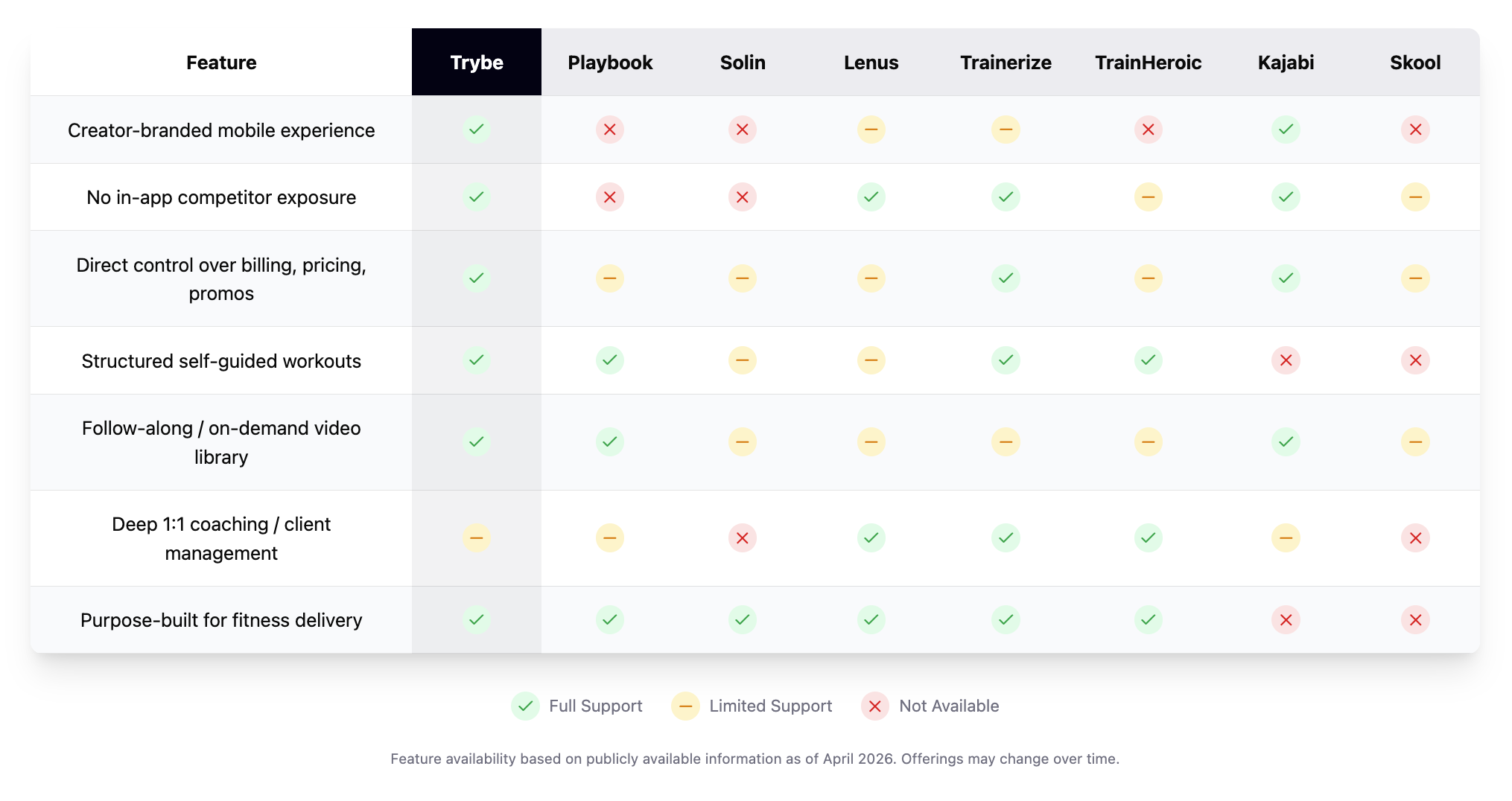
Playbook. Strong distribution for new creators who don't yet have a list. The marketplace surfaces you to people who came looking for fitness. The tradeoff is the same as any mall: every customer who buys from you is also one tap away from another creator's plan, and the second purchase often goes to whoever the algorithm surfaces next.
Solin. Similar marketplace model with a different audience. Best for creators who fit the platform's niche profile cleanly and benefit from being grouped with adjacent coaches. Same general tradeoff as Playbook on customer ownership.
Lenus. Built for the high-touch 1:1 coach. The product centers on intake, check-ins, programming, and ongoing communication, which is the right shape if your business is selling personalized coaching cycles. It's less suited if you want a creator-branded experience that feels distinctly yours, or if you're trying to scale beyond personalized coaching into self-guided content.
Trainerize. One of the most widely used 1:1 coaching tools in the industry, and for good reason. The programming and client-management features are deep. The mismatch shows up when a coach moves from "I have 30 1:1 clients" to "I have a self-guided program that should reach 3,000 people." Trainerize wasn't designed around that transition, and the experience inside the app isn't yours, which matters more the larger the audience gets.
TrainHeroic. Strong for structured strength programs, hybrid programs, and coaches operating in performance-sport contexts. The community features around team programs are a real strength. The limit is the inverse: if your content is more general fitness, mobility, or skill work, the format can feel narrow.
Kajabi. A genuinely good all-in-one for course-based businesses. If your product is courses, communities, and email funnels, Kajabi's infrastructure is hard to beat. The gap for fitness creators is that training isn't a course. It's a daily activity, and Kajabi's UX is built around lessons and modules, not workouts and progressions.
Skool. Excellent at community gamification and the small-group coaching format. The leaderboard plus course plus community design works very well for creators whose product is the conversation as much as the content. For training delivery, the mismatch is similar to Kajabi: it's web-first, course-shaped, and not optimized for the daily-use phone experience that training needs.
Trybe. Native branded iOS and Android apps purpose-built for fitness creators. Best when the creator already has audience demand and a structured offer (programs, skill tracks, lectures, progressions, follow-along libraries) and needs the daily training experience to live somewhere that feels like theirs. Not the right fit for early validation when one PDF and a Stan link is all the business needs.
The chart and the writeups are easier to use when filtered through a few simple decisions.
If you're still validating an offer, start with a storefront or a marketplace. Stan Store, Gumroad, Playbook, or Solin will get you to revenue faster than a branded app will. Build evidence that the offer works before you build the home. We've written about the moment that calculus changes here.
If your business is mostly 1:1 coaching, the strongest fits are Trainerize or Lenus. Both are built for the relationship cadence that 1:1 demands. A branded app is usually a fit only if you're trying to scale beyond 1:1 into self-guided programs.
If your product is community plus courses, Kajabi or Skool will serve that better than a training-specific app will, even if your topic is fitness. Don't overfit to a vertical when the actual product is the cohort experience.
If your product is structured training, programs, skill tracks, or rehab content that customers will use daily for months, this is where a branded fitness app earns the rebuild. Training that lives daily on the phone compounds in a way that course modules and DMs don't. The mobile-first delivery, the daily-use UX, and the brand control matter more the longer the customer stays. This is also where Trybe is built to fit.
If your audience is asking for an app by name, take that seriously. It's usually a signal that the current container has hit its ceiling. Audiences ask for apps when the offer has grown past what a download or a checkout page can hold.
No platform on this list is bad. They're built for different parts of the creator business, and the question that actually matters is which part you're in. The mistake most creators make isn't picking the wrong platform. It's outgrowing the right one and not switching when the math changes.
If your training has reached the point where it deserves a home that feels like yours, where the next session is one tap away, and where the second purchase is easier than the first, that's the moment a branded app makes sense.
If you'd like to see whether that's where you are, Trybe is built for exactly that transition. We help fitness creators turn their existing programs, lectures, and progressions into a branded, professional-grade app, without rebuilding the parts of the business that already work.